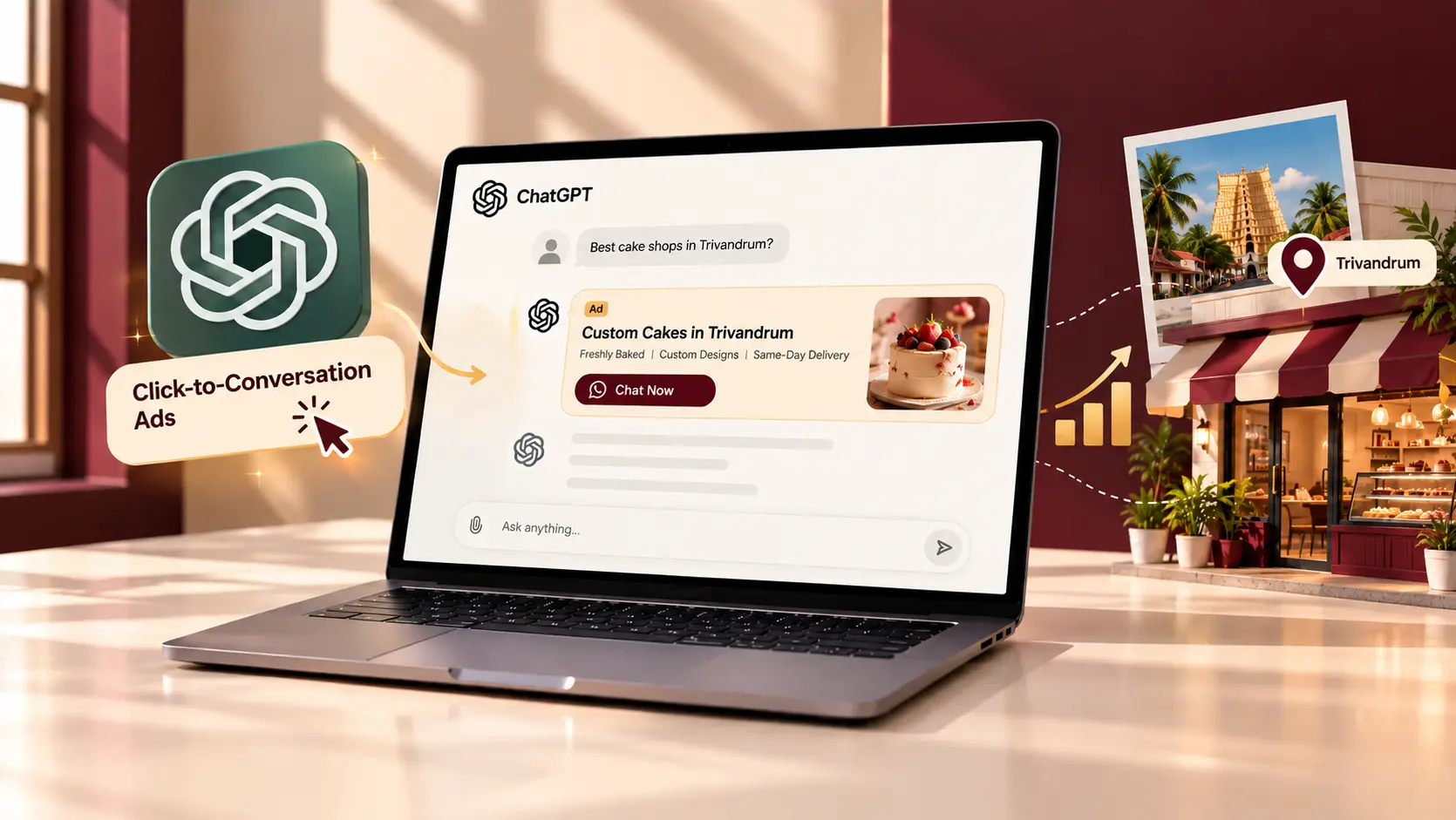
For twenty years, the entire logic of digital advertising has rested on one action: get the click, send the person to a website, hope they convert once they land. That assumption is starting to break. OpenAI is now testing an ad format inside ChatGPT that skips the website step entirely — the ad doesn’t lead to a page, it leads to a conversation, where the back-and-forth itself moves the person toward a decision or a purchase.
At the same time, review platforms like Yelp have started partnering directly with OpenAI to feed business information straight into ChatGPT’s answers, rather than keeping that data walled off on their own site. The logic driving both moves is the same: if people are increasingly asking AI assistants for recommendations instead of searching and clicking, businesses and platforms alike have to decide whether to get inside that conversation or get left out of it.
This is still early. But it’s exactly the kind of shift worth understanding before it becomes standard practice — because the businesses that adjust early usually spend less catching up later.
Why "Click to Website" Was Never Guaranteed to Last
The click-to-website model worked because search results and social feeds were, fundamentally, lists of links. Someone searched, scanned options, clicked one. Every part of digital marketing — landing pages, retargeting, conversion tracking — was built around that single moment of the click.
AI assistants don’t work as lists. They work as answers. When someone asks an AI assistant to recommend a good caterer, a salon, or a marketing consultant, the assistant doesn’t hand back ten blue links to compare — it gives a shortlist, sometimes just one name, based on what it already knows and trusts about each option. The click either happens much later, or doesn’t happen at all before a decision is made.
Advertising inside that format can’t just be a banner bolted onto an answer. It has to work as part of the conversation — which is exactly what OpenAI’s new ad tests are attempting
What This Means Beyond the Big Platforms
It’s tempting to file this under “something that only matters to huge advertisers.” It doesn’t. The underlying shift — decisions increasingly getting made inside a conversation with an AI assistant rather than through a website visit — affects any business that depends on being chosen, including a bakery in Vazhuthacaud or a freelance consultant in Kesavadasapuram.
The practical implication is this: if AI assistants are going to be a real referral channel for local businesses (and platforms partnering directly with OpenAI suggests they’re betting heavily that this will happen), then how a business is described, reviewed, and represented across the internet starts to matter as much as, or more than, how it’s advertised.
A great paid ad campaign sending traffic to a website is still worth running. But it now sits alongside a second, less visible question: if someone asks an AI assistant to recommend a business like yours, does the assistant even know you exist, and does it trust what it knows?
What a Forward-Looking Marketer Should Be Doing Now
For a business in Trivandrum, this isn’t a reason to panic or to abandon what’s already working. It’s a reason to make sure paid marketing and reputation-building aren’t treated as two separate departments:
Treat ad platforms and AI visibility as connected, not separate. A campaign that drives clicks but leaves no lasting trace of the business elsewhere online (no reviews, no mentions, no consistent listing data) is building traffic without building the kind of trust AI systems are starting to reward.
Keep business information consistent everywhere an assistant might pull it from. As platforms increasingly feed data directly into AI systems, an inaccurate address, a stale phone number, or mismatched service categories on any one platform becomes a bigger liability than it used to be.
Watch how competitors are described when someone asks an AI assistant about your category. This is a five-minute exercise, not a research project — ask ChatGPT or a similar tool a question a potential customer might ask, and see who gets mentioned. It’s a fast way to see where a business stands before spending on ads to fix a problem elsewhere.
Don’t wait for conversational ad formats to mature before building the reputation layer underneath them. By the time these ad formats are standard, the businesses with strong reviews, consistent information, and real third-party mentions will have a head start that’s hard for paid spend alone to close
The Takeaway
Advertising built entirely around getting a click to a website has had a long, dominant run — and it isn’t disappearing overnight. But the platforms themselves are already testing what comes next, and the common thread across every one of these moves is the same: trust built outside the ad, not just inside it, is becoming the thing that actually decides who gets chosen.
For a Trivandrum business, the smartest move right now isn’t necessarily to jump into a new ad format the moment it launches. It’s making sure that when an AI assistant does get asked about a business like yours, there’s already enough real, consistent evidence out there for it to say something good